Tuesday, January 28, 2014

Outlook 29 January '14

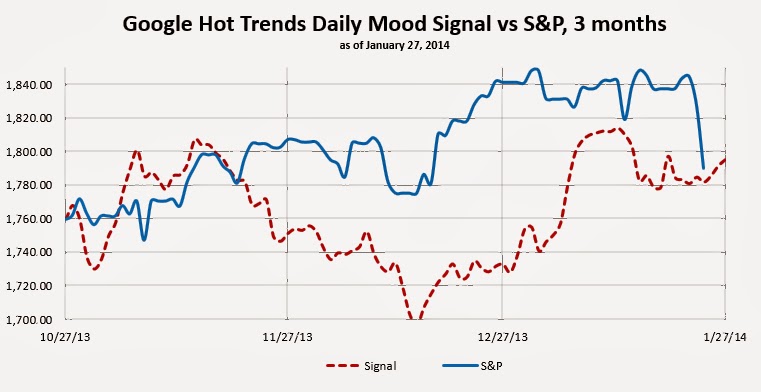
after market update: actual S&P -18.3  Futures tried and failed to get past 1800 overnight (see comments under Overview below).  Markets opened down and stayed down, yet several sharp pops showed the readiness for a relief rally.  Markets continue to be extremely oversold relative to social mood daily signals, and a major bounceback is likely just around the corner.
 
(click to enlarge)
- - -
Overview:  Collective mood shows a transition in progress.  Mood signals for the day indicate a moderate rally in the markets is likely.  Markets are extremely oversold relative to daily social mood signals and may try to stage a significant bounceback. Yet, mood signals also indicate that there should be sizeable resistance near S&P 1800.

Near Term: Global mood trends imply a profound transformation in the global landscape taking place in the background.  It may be another few days to a few weeks to really know what this is pointing to.  The social mood trend had been turning down sharply, but has reached support and has begun to turn up from there.  The market equivalent of this mood signal area is S&P 1780 - 1800.
 
Long Term: Collective mood has been in a many month long process of topping.  Long term indicators are flashing "caution," yet there is no definitive signal that a major market shift is imminent.  The impact of human and natural disasters of late has been relatively low, but the trend is toward increasing impact.  Over time, this may wear on both mood and socioeconomic stability.
 
Today's Signals: +4.8 from Google Hot Trends, +5.4 from Themes in the News.  The projected stock market change for today is shown in the chart below.

(click to enlarge)
 
 
Mood signals from Google Hot Trends: On a daily basis, markets tend to follow social mood more often than not.  Overall, social mood trend changes usually precede market trend changes.
 
  (click to enlarge)


Mood signals from themes in the news: News tends to follow the general trend of the market, but on a daily basis, can either lead or lag the movement of the market.    
 

(click to enlarge)
 
 
Note: data for U.S. social mood are scores in eight MoodCompass categories of Google Hot Trends, data for news are scores of top Google U.S. news stories.  Scores are converted to 4 inputs to the Market Mood Model.  The output is a conversion of mood data to estimated S&P point change.  Stock market data source: Google Finance.  This is posted as a public service, and to enhance exposure to our research.  It is not intended to be trading advice

Monday, January 27, 2014

Outlook 28 January '14

after market update: actual S&P +10.94  Markets were sideways all day, but the 1780 support indicated by social mood signals (see Near Term below), seems to be holding for now.  Markets continue to be extremely oversold relative to social mood daily signals, which could possibly fuel a major bounceback.
 
(click to enlarge)
- - -
Overview:  Collective mood shows a transition in progress.  Social mood signals give near term market support near S&P 1780.  Mood signals for the day indicate little net change in the markets is likely.  However, markets are extremely oversold relative to daily social mood signals and may try to bounce off of support. 
Near Term: Global mood trends imply a profound transformation in the global landscape taking place in the background.  It may be another few days to a few weeks to really know what this is pointing to.  The social mood trend had been turning down sharply, but has reached support.  This may pause or reverse the downtrend in the near term.  The market equivalent of this mood signal area is S&P 1780.
 
Long Term: Collective mood has been in a many month long process of topping.  Long term indicators are flashing "caution," yet there is no definitive signal that a major market shift is imminent.  The impact of human and natural disasters of late has been relatively low, but the trend is toward increasing impact.  Over time, this may wear on both mood and socioeconomic stability.
 
Today's Signals: -3.3 from Google Hot Trends, -0.3 from Themes in the News.  The projected stock market change for today is shown in the chart below.

(click to enlarge)
 
 
Mood signals from Google Hot Trends: On a daily basis, markets tend to follow social mood more often than not.  Overall, social mood trend changes usually precede market trend changes.
 
  (click to enlarge)


Mood signals from themes in the news: News tends to follow the general trend of the market, but on a daily basis, can either lead or lag the movement of the market.    
 

(click to enlarge)
 
 
Note: data for U.S. social mood are scores in eight MoodCompass categories of Google Hot Trends, data for news are scores of top Google U.S. news stories.  Scores are converted to 4 inputs to the Market Mood Model.  The output is a conversion of mood data to estimated S&P point change.  Stock market data source: Google Finance.  This is posted as a public service, and to enhance exposure to our research.  It is not intended to be trading advice

Rising Aggression: Outlook 27 January '14

after market update: actual S&P -8.7.  Markets were down again, but have reached the 1780 S&P area, which social mood signals indicate as a support area (see near term below).  Markets are likely to hover around and try to bounce off this area at least for a moment.
 
(click to enlarge)
- - -
Overview:  Collective mood shows a sharp rise in global aggression and willingness to take action, along with rising risk of a panic response.  Social mood signals give near term market support near S&P 1780.  Mood signals for the day indicate a moderate rally is likely.  Markets are extremely oversold relative to daily social mood signals, yet may continue to be so until reaching support. 
 
Near Term: Global mood trends show rising aggression and willingness to take action, along with rising risk of a panic response.  The social mood trend had been turning down, but has reached support.  This may pause or reverse the downtrend in the near term.  The market equivalent of this mood signal area is S&P 1780.
 
Long Term: Collective mood has been in a many month long process of topping.  Long term indicators are flashing "caution," yet there is no definitive signal that a major market shift is imminent.  The impact of human and natural disasters of late has been relatively low, but the trend is toward increasing impact.  Over time, this may wear on both mood and socioeconomic stability.
 
Today's Signals: +13.5 from Google Hot Trends, +4.5 from Themes in the News.  The projected stock market change for today is shown in the chart below.

(click to enlarge)
 
 
Mood signals from Google Hot Trends: On a daily basis, markets tend to follow social mood more often than not.  Overall, social mood trend changes usually precede market trend changes.
 
  (click to enlarge)


Mood signals from themes in the news: News tends to follow the general trend of the market, but on a daily basis, can either lead or lag the movement of the market.    
 

(click to enlarge)
 
 
Note: data for U.S. social mood are scores in eight MoodCompass categories of Google Hot Trends, data for news are scores of top Google U.S. news stories.  Scores are converted to 4 inputs to the Market Mood Model.  The output is a conversion of mood data to estimated S&P point change.  Stock market data source: Google Finance.  This is posted as a public service, and to enhance exposure to our research.  It is not intended to be trading advice

Friday, January 24, 2014

Big Bad News this Weekend?

(click here to enlarge)
 
Individually, this might be a great weekend for many people.  On a global scale, there is a big bad news story likely just around the corner.  Stock market trend changes tend to follow just behind social mood changes.  The news, on the other hand, tends to lag just behind that (believe it or not).  Social mood started showing a sharp drop beginning on January 12, 2014 (see #1 in chart above).  At this same time, the stock market was still moving sideways.  The news signal was still going up until January 22 (see #1 in chart below).

(click here to enlarge)

The market is now sharply dropping.  According to the social mood signal (see #2 in Google Hot Trend chart), it should pause at least briefly in the S&P 1780 to 1800 area.  The news signal, on the other hand, has not yet shown its sharp drop.  That may come as soon as this weekend (see #2 in News chart).  It's possible that a "big bad news story" could accompany this.  It is also possible, that a relieving news story occurs relatively soon that leads to the market pause or bounce which is also right around the corner.

Please note that these are preliminary charts and were produced with data available as of January 24.  The official January 27 chart is not released until midnight (E.T.) of January 27.  Because of this we will not yet comment on area #3 in the Google Trends chart.

Don't miss out on seeing our global and U.S. overview for the year 2104 at: http://moodcompass-world.blogspot.com/2014/01/2014-global-and-us-overview.html
 

Outlook 24 January '14

after market update: actual S&P -38.2.  Markets are quickly heading down toward S&P 1780 support as described below.  That is likely to serve as a pausing or bouncing place in the decline.
 
(click to enlarge)
- - -
Overview:  Collective mood shows uncertainty about what's going on in the world at large combined with aggression and willingness to take action.  Social mood signals give near term market support at S&P 1780.  Mood signals for the day indicate the market is likely to be down slightly.  Markets are currently oversold relative to the daily social mood signal, but may continue to be until they reach near term support. 
 
Near Term: Global mood trends show uncertainty and contrariness.  This is combining with  aggression and willingness to take action.  The social mood trend had been turning down, but has reached support.  This may pause or reverse the downtrend in the near term.  The market equivalent of this mood signal area is near S&P 1780.
 
Long Term: Collective mood has been in a many month long process of topping.  Long term indicators are flashing "caution," but there is no definitive signal that a major market shift is imminent.  The impact of human and natural disasters of late has been relatively low, but the trend is toward increasing impact.  Over time, this may wear on both mood and socioeconomic stability.
 
Today's Signals: -3.0 from Google Hot Trends, -0.4 from Themes in the News.  The projected stock market change for today is shown in the chart below.

(click to enlarge)
 
 
Mood signals from Google Hot Trends: On a daily basis, markets tend to follow social mood more often than not.  Overall, social mood trend changes usually precede market trend changes.
 
  (click to enlarge)


Mood signals from themes in the news: News tends to follow the general trend of the market, but on a daily basis, can either lead or lag the movement of the market.    
 

(click to enlarge)
 
 
Note: data for U.S. social mood are scores in eight MoodCompass categories of Google Hot Trends, data for news are scores of top Google U.S. news stories.  Scores are converted to 4 inputs to the Market Mood Model.  The output is a conversion of mood data to estimated S&P point change.  Stock market data source: Google Finance.  This is posted as a public service, and to enhance exposure to our research.  It is not intended to be trading advice

Wednesday, January 22, 2014

Social Mood Indicators Flashing CAUTION: Outlook 23 January '14

after market update: actual S&P -16.4.  Traders apparently sensed the uncertain mood and the shift in long term signals (see below).  Markets sold off almost 1%, in spite of the daily signal being near unchanged.
 
(click to enlarge)
- - -
Overview:  Collective mood shows aggression and willingness to take action combined with uncertainty about what's going on in the world at large. Mood signals for the day indicate the market is likely to remain nearly unchanged.  However, long term indicators are now flashing "CAUTION."
 
Near Term: Global mood trends show uncertainty and contrariness.  This is combining with  aggression and willingness to take action.  The social mood trend had been turning down, but has reached support.  This may pause or reverse the downtrend in the near term. The market equivalent of this mood signal area is near S&P 1780.
 
Long Term: Collective mood has been in a many month long process of topping.  Long term indicators are flashing "caution," but there is no definitive signal that a major market shift is imminent.  The impact of human and natural disasters of late has been relatively low, but the trend is toward increasing impact.  Over time, this may wear on both mood and socioeconomic stability.
 
Today's Signals: +3.8 from Google Hot Trends, +0.7 from Themes in the News.  The projected stock market change for today is shown in the chart below.

(click to enlarge)
 
 
Mood signals from Google Hot Trends: On a daily basis, markets tend to follow social mood more often than not.  Overall, social mood trend changes usually precede market trend changes.
 
  (click to enlarge)


Mood signals from themes in the news: News tends to follow the general trend of the market, but on a daily basis, can either lead or lag the movement of the market.    
 

(click to enlarge)
 
 
Note: data for U.S. social mood are scores in eight MoodCompass categories of Google Hot Trends, data for news are scores of top Google U.S. news stories.  Scores are converted to 4 inputs to the Market Mood Model.  The output is a conversion of mood data to estimated S&P point change.  Stock market data source: Google Finance.  This is posted as a public service, and to enhance exposure to our research.  It is not intended to be trading advice.

Outlook 22 January '14

after market update: actual S&P +1.1.  Right in line with social mood signals, market nearly unchanged.
 
(click to enlarge)
- - -
Overview:  Collective mood shows aggression and willingness to take action. Mood signals for the day indicate the market is likely to remain nearly unchanged.
 
Near Term: Global mood trends show uncertainty and contrariness.  This is combining with  aggression and willingness to take action.  Social mood trend had been turning down, but has reached support.  This may pause or reverse the downtrend in the near term. 
 
Long Term: Collective mood has been in a many month long process of topping, but there is no sign that a major market shift is imminent.  The impact of human and natural disasters of late has been relatively low, but the trend is toward increasing impact.  Over time, this may wear on both mood and socioeconomic stability.
 
Today's Signals: -2.3 from Google Hot Trends, -1.7 from Themes in the News.  The projected stock market change for today is shown in the chart below.

(click to enlarge)
 
 
Mood signals from Google Hot Trends: On a daily basis, markets tend to follow social mood more often than not.  Overall, social mood trend changes usually precede market trend changes.
 
  (click to enlarge)


Mood signals from themes in the news: News tends to follow the general trend of the market, but on a daily basis, can either lead or lag the movement of the market.    
 

(click to enlarge)
 
 
Note: data for U.S. social mood are scores in eight MoodCompass categories of Google Hot Trends, data for news are scores of top Google U.S. news stories.  Scores are converted to 4 inputs to the Market Mood Model.  The output is a conversion of mood data to estimated S&P point change.  Stock market data source: Google Finance.  This is posted as a public service, and to enhance exposure to our research.  It is not intended to be trading advice.