Tuesday, January 21, 2014

Uncertain Exuberance: Outlook 21 Jan '14

after market update: actual S&P +5.1.  Great day of exemplifying social mood playing out in the markets-- a large rally followed by a large drop followed by a mediocre rally.  Awesome!
 
(click to enlarge)
- - -
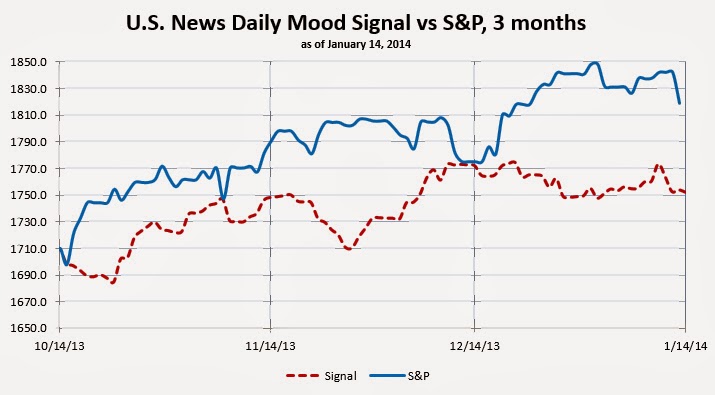
Overview:  Collective mood shows sharply rising aggression and willingness to take action. Mood signals for the day indicate a market that would like to rally significantly, but is still overbought relative to social mood and might have difficulty making or maintaining the large upward move suggested by mood signals.
 
Near Term: Global mood trends show sharply rising uncertainty and contrariness.  This is combining with rising aggression and willingness to take action.  Social mood trend had been turning down, but has reached support.  This may pause or reverse the downtrend in the near term. 
 
Long Term: Collective mood has been in a many month long process of topping, but there is no sign that a major market shift is imminent.  The impact of human and natural disasters of late has been relatively low, but the trend is toward increasing impact.  Over time, this may wear on both mood and socioeconomic stability.
 
Today's Signals: +4.5 from Google Hot Trends, +18.6 from Themes in the News.  The projected stock market change for today is shown in the chart below.

(click to enlarge)
 
 
Mood signals from Google Hot Trends: On a daily basis, markets tend to follow social mood more often than not.  Overall, social mood trend changes usually precede market trend changes.
 
  (click to enlarge)


Mood signals from themes in the news: News tends to follow the general trend of the market, but on a daily basis, can either lead or lag the movement of the market.    
 

(click to enlarge)
 
 
Note: data for U.S. social mood are scores in eight MoodCompass categories of Google Hot Trends, data for news are scores of top Google U.S. news stories.  Scores are converted to 4 inputs to the Market Mood Model.  The output is a conversion of mood data to estimated S&P point change.  Stock market data source: Google Finance.  This is posted as a public service, and to enhance exposure to our research.  It is not intended to be trading advice.

Thursday, January 16, 2014

Stuck in Uncertainty: Outlook 17 January '14

after market update: actual S&P -9.4.  Markets rose to unchanged and retreated, trying to correct the over-exuberance of the past few days.
 
(click to enlarge)
- - -
Overview:  Collective mood shows sharply rising uncertainty and ambiguity. Mood signals for the day indicate a market that has little room left to rise, and markets highly overbought relative to social mood.  In other words, it wouldn't take much of a nudge to initiate a sharp sell-off, but a big rally is really tough to get going.
 
Near Term: Global mood trends show sharply rising uncertainty and ambiguity.  Near term social mood trend had been pushing against a "ceiling" (see Google Hot Trends chart below) but now  appears in process of turning down sharply. 
 
Long Term: Collective mood has been in a many month long process of topping, but there is no sign that a major market shift is imminent.  The impact of human and natural disasters of late has been relatively low, but the trend is toward increasing impact.  Over time, this may wear on both mood and socioeconomic stability.
 
Today's Signals: -7.0 from Google Hot Trends, +8.3 from Themes in the News.  The projected stock market change for today is shown in the chart below.

(click to enlarge)
 
 
Mood signals from Google Hot Trends: On a daily basis, markets tend to follow social mood more often than not.  Overall, social mood trend changes usually precede market trend changes.
 
  (click to enlarge)


Mood signals from themes in the news: News tends to follow the general trend of the market, but on a daily basis, can either lead or lag the movement of the market.    
 

(click to enlarge)
 
 
Note: data for U.S. social mood are scores in eight MoodCompass categories of Google Hot Trends, data for news are scores of top Google U.S. news stories.  Scores are converted to 4 inputs to the Market Mood Model.  The output is a conversion of mood data to estimated S&P point change.  Stock market data source: Google Finance.  This is posted as a public service, and to enhance exposure to our research.  It is not intended to be trading advice.

Wednesday, January 15, 2014

Outlook16 January '14

after market update: actual S&P -2.5.  Markets retreated from highs in a mostly sideways motion in line with social mood.  Markets remain highly overbought relative to collective mood signals.
 
(click to enlarge)
- - -
Overview:  Collective mood shows rising uncertainty and ambiguity. Mood signals for the day indicate a market that has little room left to rise, and markets are highly overbought relative to social mood.  In other words, it wouldn't take much of a nudge to initiate a sharp sell-off.
 
Near Term: Global mood trends show sharply rising uncertainty and ambiguity.  Near term social mood trend had been pushing against a "ceiling"(see Google Hot Trends chart below) but is now in process of turning down sharply. 
 
Long Term: Collective mood has been in a many month long process of topping, but there is no sign that a major market shift is imminent.  The impact of human and natural disasters of late has been relatively low, but the trend is toward increasing impact.  Over time, this may wear on both mood and socioeconomic stability.
 
Today's Signals: +3.0 from Google Hot Trends, +0.2 from Themes in the News.  The projected stock market change for today is shown in the chart below.

(click to enlarge)
 
 
Mood signals from Google Hot Trends: On a daily basis, markets tend to follow social mood more often than not.  Overall, social mood trend changes usually precede market trend changes.
 
  (click to enlarge)


Mood signals from themes in the news: News tends to follow the general trend of the market, but on a daily basis, can either lead or lag the movement of the market.    
 

(click to enlarge)
 
 
Note: data for U.S. social mood are scores in eight MoodCompass categories of Google Hot Trends, data for news are scores of top Google U.S. news stories.  Scores are converted to 4 inputs to the Market Mood Model.  The output is a conversion of mood data to estimated S&P point change.  Stock market data source: Google Finance.  This is posted as a public service, and to enhance exposure to our research.  It is not intended to be trading advice.

Tuesday, January 14, 2014

Panic or Disaster Imminent? - Outlook 15 January '14

after market update: actual S&P +9.5.  Markets rallied to new record highs, and are now seriously overbought relative to collective mood signals which have turned sharply down.
 
(click to enlarge)
- - -
Overview:  Collective mood shows rising perceptions of deterioration or disaster. Themes in the news reflect a perception of instability and uncertainty.  Mood signals for the day indicate a wide market range possible, from little changed to a sharp sell-off.
 
Near Term: Global mood trends show sharply rising instability and perceptions of deterioration or destruction.  Near term social mood trend had been pushing against a "ceiling"(see Google Hot Trends chart below) but is now in process of turning down sharply. 
 
Long Term: Collective mood has been in a many month long process of topping, but there is no sign that a major market shift is imminent.  The impact of human and natural disasters of late has been relatively low, but the trend is toward increasing impact.  Over time, this may wear on both mood and socioeconomic stability.
 
Today's Signals: -19.8 from Google Hot Trends, +4.4 from Themes in the News.  The projected stock market change for today is shown in the chart below.

(click to enlarge)
 
 
Mood signals from Google Hot Trends: On a daily basis, markets tend to follow social mood more often than not.  Overall, social mood trend changes usually precede market trend changes.
 
  (click to enlarge)


Mood signals from themes in the news: News tends to follow the general trend of the market, but on a daily basis, can either lead or lag the movement of the market.    
 

(click to enlarge)
 
 
Note: data for U.S. social mood are scores in eight MoodCompass categories of Google Hot Trends, data for news are scores of top Google U.S. news stories.  Scores are converted to 4 inputs to the Market Mood Model.  The output is a conversion of mood data to estimated S&P point change.  Stock market data source: Google Finance.  This is posted as a public service, and to enhance exposure to our research.  It is not intended to be trading advice.

Monday, January 13, 2014

Outlook 14 January '14

after market update: actual S&P +19.7.  Collective mood signals showed little change to moderate sell-off, but today the markets went up and up.  Because of this markets are now highly overbought relative to collective mood signals.
 
- - -
Overview: A new global chapter continues to unfold, and things are looking shaky.  Collective mood reflects the perception of a new chapter beginning.  Themes in the news reflect a perception of instability and uncertainty.  Mood signals for the day indicate little change to a moderate sell-off in the market is likely.
 
Near Term: Global mood trends show rising instability and uncertainty.  Near term social mood trend has been pushing against a "ceiling"(see Google Hot Trends chart below) but seems to now be in process of turning down. 
 
Long Term: Collective mood has been in a many month long process of topping, but there is no sign that a major market shift is imminent.  The impact of human and natural disasters of late has been relatively low, but the trend is toward increasing impact.  Over time, this may wear on both mood and socioeconomic stability.
 
Today's Signals: -7.4 from Google Hot Trends, -1.8 from Themes in the News.  The projected stock market change for today is shown in the chart below.

(click to enlarge)
 
 
Mood signals from Google Hot Trends: On a daily basis, markets tend to follow social mood more often than not.  Overall, social mood trend changes usually precede market trend changes.
 
  (click to enlarge)


Mood signals from themes in the news: News tends to follow the general trend of the market, but on a daily basis, can either lead or lag the movement of the market.    
 

(click to enlarge)
 
 
Note: data for U.S. social mood are scores in eight MoodCompass categories of Google Hot Trends, data for news are scores of top Google U.S. news stories.  Scores are converted to 4 inputs to the Market Mood Model.  The output is a conversion of mood data to estimated S&P point change.  Stock market data source: Google Finance.  This is posted as a public service, and to enhance exposure to our research.  It is not intended to be trading advice.

2014 Global and U.S. Overview

Projecting forward the cycles of collective mood and perception for 2014 gives us the following likely scenarios (at the end of this post is a link to download more complete info).

Global:

    March/April –Fuel Prices Soar on Iranian Nuke issue

    May/June –Uncertain Response Inflames Israel

    August –Iran Deal Proposed (Hillary-style)

    September –CPI Remains High, Markets Choppy

    October –Incumbents Worried

United States Government:

    Primary themes of bickering, inaction, indecision, and confusion

    March/April - U.S. government in crisis mode

2014 and You -- see the presentation pdf

Feel free to download your copy of the MoodCompass team's overview of 2014 here.
- - -

Update 16 January '14 A Bill Stokes Debate, and Doubt, on Iran Deal

Sunday, January 12, 2014

A New Chapter of Global Bad News: Outlook 13 January '14

after market update: actual S&P -23.17.  Large stock market sell-offs are often the first clear symptom of more bad news to come.  Thus begins this "bad news" chapter as Wall Street lost over 1% in a sharp decline.  Watch for a climax in global bad news before this is over.

(click to enlarge)
- - -
Overview: A new global chapter is unfolding, and it looks like trouble is brewing.  Collective mood reflects the perception of a new chapter beginning.  Themes in the news reflect a perception of instability and general "Bad News."  Mood signals for the day indicate a moderate to sharp sell-off in the market is likely.
 
Near Term: Global mood trends are in transition; the markets have been going sideways.  Near term social mood trend has been pushing against a "ceiling" but seems to now be in process of turning down.
 
Long Term: Collective mood has been in a many month long process of topping, but there is no sign that a major market shift is imminent.  The impact of human and natural disasters of late has been relatively low, but the trend is toward increasing impact.  Over time, this may wear on both mood and socioeconomic stability.
 
Today's Signals: -2.5 from Google Hot Trends, -19.5 from Themes in the News.  The projected stock market change for today is shown in the chart below.

(click to enlarge)
 
 
Mood signals from Google Hot Trends: On a daily basis, markets tend to follow social mood more often than not.  Overall, social mood trend changes usually precede market trend changes.
 
  (click to enlarge)


Mood signals from themes in the news: News tends to follow the general trend of the market, but on a daily basis, can either lead or lag the movement of the market.    
 

(click to enlarge)
 
 
Note: data for U.S. social mood are scores in eight MoodCompass categories of Google Hot Trends, data for news are scores of top Google U.S. news stories.  Scores are converted to 4 inputs to the Market Mood Model.  The output is a conversion of mood data to estimated S&P point change.  Stock market data source: Google Finance.  This is posted as a public service, and to enhance exposure to our research.  It is not intended to be trading advice.